


What HCG is
HCG (chorionic gonadotropin) is not a peptide in the usual catalog sense but a glycoprotein: two different polypeptide chains held together without any covalent link between them. The alpha subunit has 92 amino acids and the beta subunit 145. Each chain is internally cross-linked by disulfide bonds arranged in a cystine-knot fold, and each carries carbohydrate, with two N-linked glycans on the alpha chain, two on the beta chain, and a cluster of O-linked glycans on the extended C-terminal segment that is unique to the beta subunit.
The alpha subunit is shared across the glycoprotein hormone family, so HCG, LH, FSH and TSH all use essentially the same alpha chain and are told apart by their beta subunits. The HCG beta chain is closest to that of LH but is longer, and the C-terminal extension with its O-glycans is the clearest structural marker separating the two.
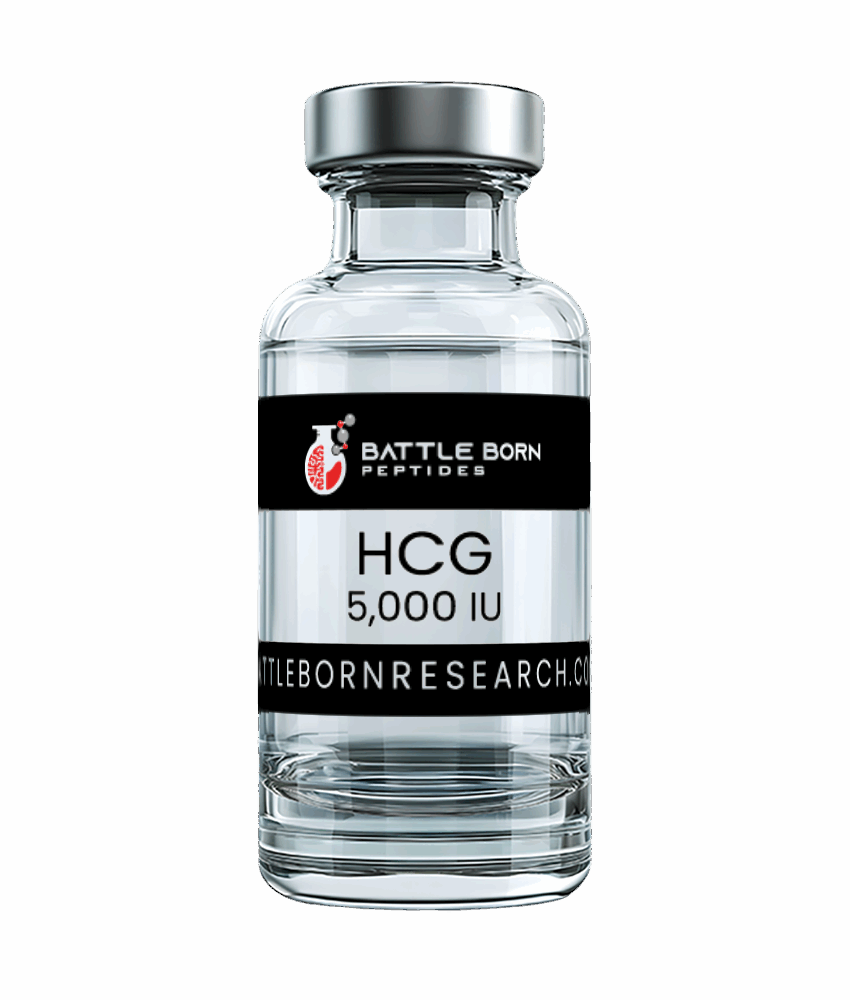
HCG 5000 IU specification
| Catalog name | HCG (chorionic gonadotropin) |
|---|---|
| Composition | Non-covalent heterodimer: alpha subunit (92 residues) and beta subunit (145 residues), N- and O-glycosylated |
| Molecular formula | Not applicable (heterogeneous glycoprotein) |
| Content per vial | 5000 IU |
| Form | Lyophilized powder, sealed vial |
| HPLC purity | ≥98% |
| Shelf life | 36 months as supplied |
How HCG is analyzed
Glycoproteins behave very differently from small synthetic peptides on a column. The acidic, organic conditions of reverse-phase HPLC tend to pull the non-covalent dimer apart, so the alpha and beta chains can appear as separate peaks rather than one. Variable sialic acid content creates a family of glycoforms that broadens each peak, which is why charge-based methods and glycan profiling complement reverse-phase work. Intact mass spectrometry returns a broad envelope instead of a single sharp value. Aromatic residues in the polypeptide chains give a 280 nm signal in addition to the peptide-bond absorbance.
The same heterogeneity explains the label. A population of glycoforms has no single molecular mass, so a milligram figure would not describe a fixed number of identical molecules. HCG is instead quantified in International Units, assigned by comparison with an International Standard reference preparation held under the World Health Organization, and the ratio between units and milligrams depends on that standard and on the glycoform mix rather than being a constant.
HCG’s reverse-phase HPLC result is published on this product page. The vials themselves are free of lot or batch markings, so the crimp and cap color is used to connect each vial with its published analysis.
Research contexts for HCG
- Glycan profiling and sialic acid analysis of a heterodimeric glycoprotein
- Subunit dissociation and reassociation studies of non-covalent protein complexes
- LH/CG receptor (LHCGR) binding assays in transfected cell lines
- Structural comparison of beta subunits across the glycoprotein hormone family
HCG 5000 IU is supplied as a biochemical reagent for in-vitro study and is not a medicinal product.
HCG questions
Why does HCG have no single molecular formula?
Its carbohydrate chains vary between molecules. The two polypeptide sequences are fixed, but the total composition is not.
Why might the chromatogram show two main peaks?
The alpha and beta chains are held together non-covalently, and reverse-phase conditions can separate them, so each subunit may elute on its own.
How is HCG related to LH?
They share the same alpha subunit. Their beta subunits are closely related, but the HCG beta chain carries an additional O-glycosylated C-terminal extension.
Buying HCG 5000 IU in the USA
HCG 5000 IU ships within the US with a tracked service, and orders totaling over $100 carry no shipping fee. Bulk pricing is open to groups that need a consistent glycoprotein reference for ongoing analytical series. We supply only research institutions, licensed researchers, universities and laboratory R&D purchasers. For how hCG is characterized and why it is labeled in units, see What Is hCG? Why a 5,000 IU Vial Is Measured in Units, Not Milligrams.
HCG 5000 IU is a laboratory reagent for in-vitro research only; it is not for human or veterinary use.


2 reviews for HCG 5000 IU
There are no reviews yet.