
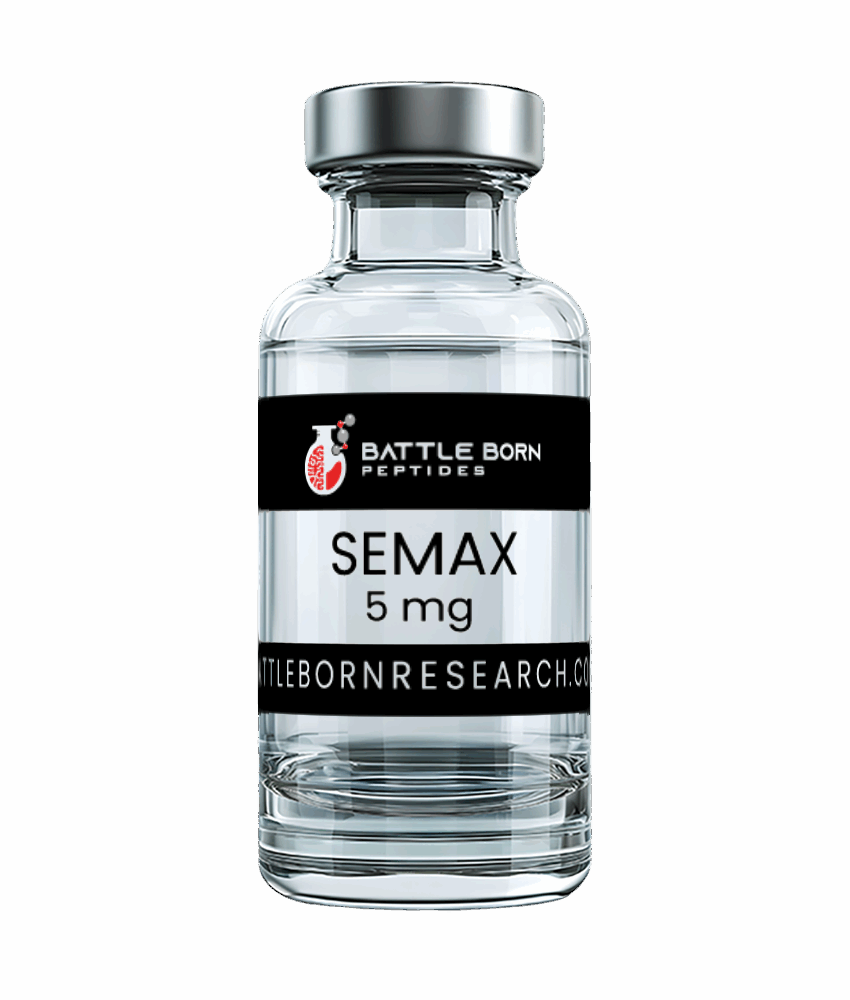



What Semax is
Semax is a synthetic heptapeptide, Met-Glu-His-Phe-Pro-Gly-Pro (MEHFPGP), with the formula C37H51N9O10S and an average mass of about 813.9 g/mol. Its first four residues match positions 4 to 7 of adrenocorticotropic hormone (ACTH); the final three, Pro-Gly-Pro, are a designed extension rather than part of the parent sequence. It is often called an ACTH(4–10) analog, but only residues 4 through 7 are retained, so ACTH(4–7)-PGP is the more accurate shorthand.
Semax does not belong to the short bioregulator family. Its real catalog neighbor is Selank, which carries the identical Pro-Gly-Pro tail on an unrelated parent, the tuftsin tetrapeptide. Beyond that shared tail the two have nothing in common, and their masses are roughly 62 Da apart.
Semax 5mg specification
| Catalog name | Semax |
|---|---|
| Sequence | H-Met-Glu-His-Phe-Pro-Gly-Pro-OH (MEHFPGP) |
| Molecular formula | C37H51N9O10S |
| Average mass | approx. 813.9 g/mol |
| CAS number | 80714-61-0 |
| Amount per vial | 5 mg |
| Form | Lyophilized powder |
| HPLC purity | ≥98% |
| Shelf life | 24 months in the sealed vial |
How Semax is analyzed
The N-terminal methionine is the residue to watch. Its thioether sulfur oxidizes easily to the sulfoxide, which shows up as a companion ion 16 Da above the parent, near 830, and, being more polar, usually elutes just ahead of the main peak as a leading shoulder. Oxidation also creates a new stereocenter at sulfur, so the sulfoxide can appear as a small doublet. A steep gradient can bury it under the main peak and inflate the purity figure, which is why a shallow gradient across the elution window matters for this sequence. Phenylalanine is the only aromatic residue and absorbs weakly, so quantitation belongs in the 214 to 220 nm range rather than at 280 nm. The two prolines can add some cis–trans broadening of their own.
The independent reverse-phase HPLC purity for Semax is reported on this page. Semax vials carry no lot number, so a vial is paired with its published test by crimp and cap color.
Research contexts for Semax
- Melanocortin receptor pharmacology in vitro with an ACTH(4–7)-derived fragment
- Exopeptidase stability assays comparing Pro-Gly-Pro-extended peptides with their parent fragments
- LC-MS methods for tracking methionine sulfoxide and its diastereomers
- Side-by-side analytical comparison with Selank
Semax is offered strictly as an in-vitro research compound and is not intended for any human or animal use.
Semax questions
Why is Semax sometimes described as an ACTH(4–10) analog?
The label names the region it was derived from. Only Met-Glu-His-Phe is kept from ACTH; the native Arg-Trp-Gly at positions 8 to 10 is replaced by Pro-Gly-Pro.
What is the peak 16 Da heavier than Semax?
Almost always methionine sulfoxide, the singly oxidized form of the peptide. It is a distinct species and should be resolved and reported rather than integrated into the main peak.
Does Semax absorb at 280 nm?
Only weakly, through its single phenylalanine; it has no tryptophan or tyrosine. A purity figure taken at 280 nm would under-count non-aromatic impurities, so the low-UV reading is the meaningful one.
Buying Semax 5mg in the USA
Semax 5mg ships inside the US with tracking, and orders above $100 ship free. For repeated assay runs, ask about bulk pricing. Semax is available solely to research institutions, licensed researchers, universities and laboratory R&D purchasers. For sequence background see What Is Semax? Sequence, Identity and Analytical Profile, and for the oxidation question in depth, Semax and Methionine Oxidation: Reading the +16 Da Companion Peak.
Semax 5mg is a laboratory research chemical and is not for human or veterinary use in any form.

Reviews
There are no reviews yet.