
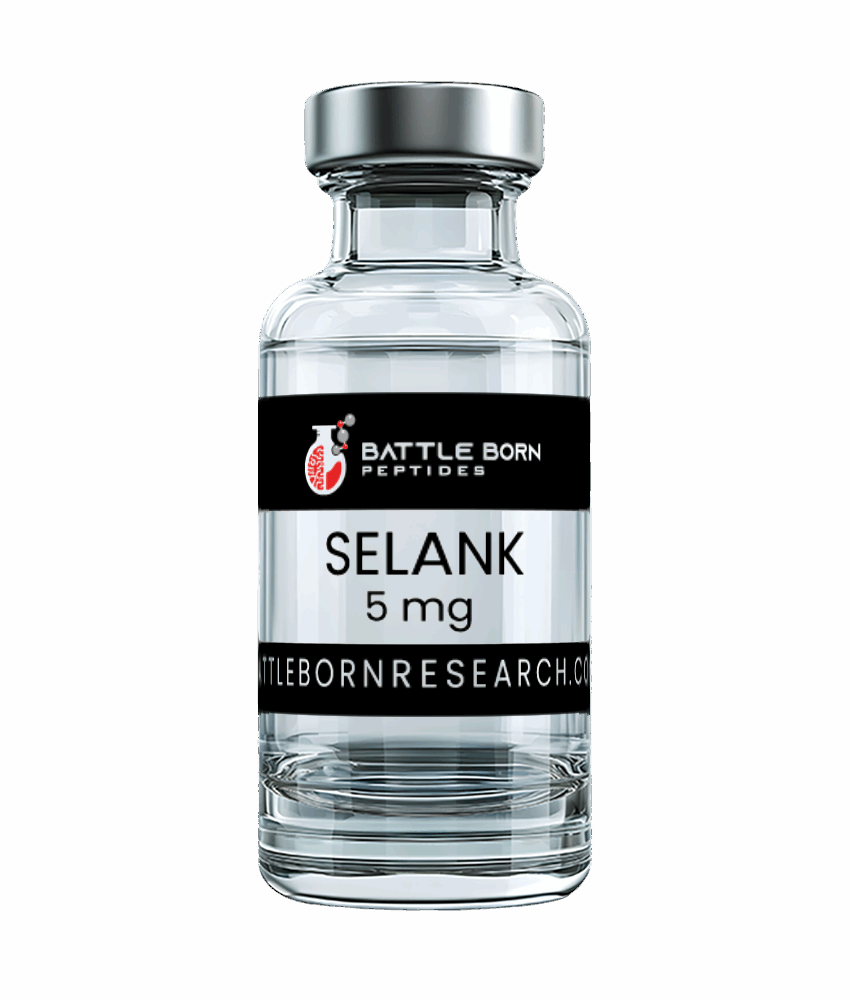

What Selank is
Selank is the heptapeptide Thr-Lys-Pro-Arg-Pro-Gly-Pro (TKPRPGP), molecular formula C33H57N11O9 and average mass near 751.9 g/mol. It joins two pieces of different origin: the natural tetrapeptide tuftsin (Thr-Lys-Pro-Arg), which is released by cleavage from the heavy chain of immunoglobulin G, and a synthetic Pro-Gly-Pro extension at the C-terminus designed to shield the short chain from exopeptidase trimming.
The same tail appears on Semax, which is why the two are so often listed together, but their front halves share nothing and Semax is some 62 Da heavier. Tuftsin on its own is a separate substance with its own registry number, so documentation describing tuftsin should not be read as describing Selank.
Selank 5mg specification
| Catalog name | Selank |
|---|---|
| Sequence | H-Thr-Lys-Pro-Arg-Pro-Gly-Pro-OH (TKPRPGP) |
| Molecular formula | C33H57N11O9 |
| Average mass | approx. 751.9 g/mol |
| CAS number | 129954-34-3 |
| Amount per vial | 5 mg |
| Form | Lyophilized powder, sealed |
| HPLC purity | ≥98% |
| Shelf life | 24 months unopened |
How Selank is analyzed
Three of Selank’s seven residues are proline, and each prolyl bond can adopt cis or trans geometry. The resulting population of slowly interconverting conformers tends to broaden the peak or leave a shoulder, a property of one molecule that is most reliably settled by checking that the mass stays constant across the peak. The sequence has lysine and arginine but no acidic side chains, so it is strongly basic: the ion-pairing additive carries much of its retention, silanol tailing is common, and bound counter-ion pulls net peptide content noticeably below chromatographic purity. With no Trp, Tyr or Phe, a 280 nm trace barely sees the peptide or its related impurities, and only a low-UV purity figure means anything. Having no Met, Cys or Trp keeps oxidation minor; the more plausible related species are deletion sequences, such as one missing a proline, 97 Da light.
Selank’s result from independent reverse-phase HPLC is listed on this page. The label carries no lot or batch code; instead, you read the crimp and cap color on a Selank vial to find its published test.
Research contexts for Selank
- Exopeptidase stability comparisons between tuftsin and its Pro-Gly-Pro-extended form
- Prolyl cis–trans conformer analysis by HPLC and NMR
- Deletion-sequence profiling by LC-MS for proline-rich synthetic peptides
- Paired analytical studies with Semax, which shares the C-terminal tail
Selank is available as an in-vitro research material only and is not for use in people or animals.
Selank questions
How does Selank relate to tuftsin?
Its first four residues are the tuftsin sequence. Selank adds Pro-Gly-Pro at the C-terminus, making it a longer, heavier and chemically distinct compound.
Why would a Selank chromatogram look cleaner at 280 nm?
Because almost nothing in the sample absorbs there. A tidy 280 nm trace reflects the detector setting rather than the material, and the 214 to 220 nm reading is the one to rely on.
What does a signal about 97 Da below Selank indicate?
A deletion sequence lacking one proline, a typical synthesis byproduct for this sequence. It is a different molecule and should be resolved from the main peak.
Buying Selank 5mg in the USA
Selank 5mg travels from a US origin on a tracked service, with free shipping applied to orders above $100. Laboratories with ongoing work can request bulk pricing. Selank orders are restricted to research institutions, licensed researchers, universities and laboratory R&D purchasers. The structural background is set out in What Is Selank? Sequence, Identity and Analytical Profile and in Selank Structure: Tuftsin Core, Pro-Gly-Pro Tail and Purity Checks.
Selank 5mg is restricted to in-vitro research and is not for human or veterinary use.


Reviews
There are no reviews yet.