


An analyst reviewing purity documentation for Selank from two sources finds one chromatogram recorded at 220 nm and another at 280 nm. The 280 nm trace shows a tidy main peak and a purity figure above 99 percent. The 220 nm trace shows more small peaks and a lower figure. The instinct is to trust the higher number. For this particular heptapeptide, that instinct is wrong, and the reason lies in its sequence. Understanding where Selank comes from structurally, and why its three C-terminal residues are there, explains both its design and how it should be analyzed.
A natural fragment with an engineered extension
Selank’s sequence is Thr-Lys-Pro-Arg-Pro-Gly-Pro, written in one-letter code as TKPRPGP. It has two parts with different origins.
- Thr-Lys-Pro-Arg is tuftsin, a naturally occurring tetrapeptide. Tuftsin is not synthesized by cells as a standalone peptide; it is released by enzymatic cleavage from the heavy chain of immunoglobulin G.
- Pro-Gly-Pro is a synthetic addition at the C-terminus.
That makes Selank a naturally occurring fragment with a designed tail, which is a different kind of molecule from an analog built to resemble a natural sequence. The broader profile of the compound as a research material is in what is Selank peptide.
Why a four-residue peptide needs protection
Short linear peptides are vulnerable to exopeptidases, enzymes that remove residues one at a time from the ends of a chain. A tetrapeptide offers very little chain to work through before nothing recognizable remains. In enzymatic stability studies, the brevity of tuftsin is exactly what makes it fragile, and the Pro-Gly-Pro extension was designed to address that.
What proline contributes to stabilization
Proline is unusual among the standard amino acids. Its side chain loops back and bonds to its own backbone nitrogen, forming a ring. That ring has two structural consequences:
- The backbone nitrogen carries no amide hydrogen, removing a hydrogen-bond donor that many enzyme active sites rely on.
- The ring restricts rotation around the backbone, locking the local chain into a narrow range of angles.
Many proteases cannot accommodate that constrained geometry in their active sites. A proline next to a bond makes that bond harder to cleave, and a proline-glycine-proline run at the C-terminus is a considerably stronger barrier. The tail is therefore not a binding motif or decoration; its purpose is stabilization against enzymatic degradation, so that the molecule persists long enough to be studied in vitro.
The same strategy appears in Semax, an ACTH-derived fragment carrying the identical Pro-Gly-Pro extension. Two unrelated parent sequences, one stabilization approach. See what is Semax peptide.
The analytical trap: no aromatic residues
Read the sequence again: threonine, lysine, proline, arginine, proline, glycine, proline. It contains no tryptophan, tyrosine or phenylalanine. That matters because of how HPLC purity is measured.
| Detection wavelength | What absorbs | Consequence for Selank |
|---|---|---|
| 214 to 220 nm | The peptide bond itself, present in every peptide | Selank and its peptide-related impurities are all visible |
| 280 nm | Mainly aromatic side chains | Selank absorbs very weakly; so do most related impurities |
A purity figure measured at 280 nm on a sequence with no aromatic residues says little. The main peak and most of its impurities are barely detected, and a small signal from something that does absorb there can dominate the calculation. That is the situation in the opening example. For Selank, the detection wavelength printed on the chromatogram is the first thing to check. Guidance on reading the rest of the trace is in how to read an HPLC chromatogram.
Behavior on a reverse-phase column
Selank carries a lysine and an arginine, both positively charged under typical acidic mobile-phase conditions, and has almost no hydrophobic bulk. It is a very polar molecule and elutes early on reverse-phase columns, sometimes close enough to the void that a shallow gradient is needed to separate it from co-eluting material. Differences in gradient and column can therefore produce noticeably different purity figures for the same material, which is one reason two reports on Selank may not agree without either being in error.
Identity values to cross-check
Names are used loosely; formulas and registry numbers are not. When comparing listings or documents, these are the values to match:
- Sequence: TKPRPGP
- Molecular formula: C33H57N11O9
- Molecular weight: approximately 751.9 g/mol
- CAS registry number: 129954-34-3
Mass spectrometry resolves the intact heptapeptide from a deletion sequence missing one proline, since the difference is a whole residue. Tuftsin alone is a different substance with its own registry number and should not be confused with Selank.
Which impurities are plausible for this sequence
The composition of Selank narrows the list of degradation and synthesis products an analyst should expect. It contains no cysteine, so there is no free thiol to oxidize and no disulfide to scramble. It contains no methionine or tryptophan, the residues most readily oxidized in many peptides. The more plausible related species are synthesis byproducts such as deletion sequences, with one of the three prolines being a natural candidate, and truncated chains. Because several of these are short and polar, they are likely to elute early, near the main peak and the void, which again puts weight on the gradient and on the choice of a low detection wavelength.
A related practical point concerns documents that report a mass alongside the chromatogram. Because Selank has no aromatic chromophore, a weak UV signal and a strong mass signal can coexist for the same peak. An analyst should not read a small UV area as evidence of little material, nor read a large mass spectral signal as evidence of high purity. The UV trace at low wavelength speaks to relative amounts; the mass speaks to identity. Each answers its own question.
What Battle Born publishes
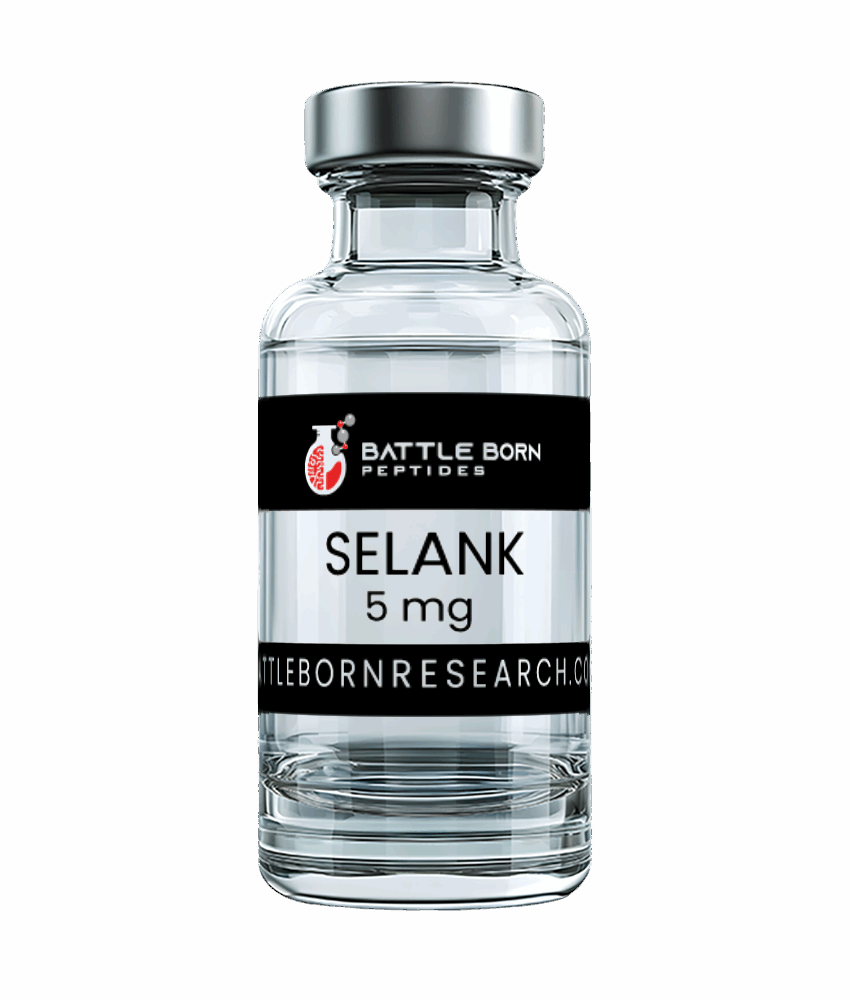
Battle Born supplies Selank as a laboratory reference material and publishes an independent reverse-phase HPLC result for the product. Given the points above, a reader should look first at the detection wavelength and the separation of the main peak from early-eluting material when evaluating that or any other Selank chromatogram.
Questions
Is Selank the same as tuftsin?
No. Tuftsin is the four-residue fragment Thr-Lys-Pro-Arg. Selank is tuftsin plus a synthetic Pro-Gly-Pro extension, a seven-residue molecule with a different formula and registry number.
Why does proline slow enzymatic cleavage?
Its ring removes the backbone amide hydrogen and constrains backbone angles, so many proteases cannot position the adjacent bond for cleavage.
Which wavelength should a Selank purity result use?
A low UV wavelength around 214 to 220 nm, where the peptide bond absorbs. At 280 nm an aromatic-free sequence is nearly invisible, and the resulting figure is not meaningful.
Research use only. All products supplied by Battle Born Peptides are laboratory reference materials for in-vitro research and analytical use by qualified professionals. They are not drugs, foods, dietary supplements, cosmetics or medical devices; they are not approved by the FDA or any other regulator for use in humans or animals; and they are not intended to diagnose, treat, cure, mitigate or prevent any disease, or to affect the structure or any function of the body of humans or animals. Nothing in this article is preparation, handling or dosing guidance. See our full research-use terms.