


A peptide purified by reverse-phase HPLC with trifluoroacetic acid in the mobile phase usually leaves the freeze dryer as a trifluoroacetate salt. Each protonated amine, guanidinium or imidazolium group on the chain can pair with one trifluoroacetate anion, and in a short, basic sequence those anions can account for a quarter of the weighed solid. None of that mass shows up in a purity chromatogram, because the counter-ion is not integrated as part of the peptide peak.
Two techniques carry most counter-ion work: ion chromatography, which separates and quantifies small anions, and fluorine-19 NMR, which sees trifluoroacetate and essentially nothing else in a typical peptide sample. This article covers what each one measures, how results are expressed, and what evidence shows that a TFA-to-acetate or TFA-to-chloride exchange really took place. It describes analytical methods only; it is not a procedure for carrying out an exchange.
Why a counter-ion figure is measured separately from purity
A lyophilized peptide is a mixture of the peptide itself, its counter-ions, residual water and small amounts of solvent. Purity by HPLC answers a relative question: of the UV-absorbing peptide material, how much is the target sequence. Content answers an absolute one: how much of the weighed powder is peptide at all. Amino acid analysis supplies the peptide fraction, Karl Fischer titration supplies water, and a counter-ion assay supplies the remaining large term. The distinction between the two kinds of number is laid out in peptide purity vs net peptide content, and the role of amino acid analysis is covered separately.
Ion chromatography with suppressed conductivity
In anion-exchange ion chromatography the sample passes through a column carrying fixed positive charges, and anions are retained according to their charge and size. The eluent is usually a hydroxide or carbonate solution. After the column, a suppressor exchanges the eluent cations for protons, turning a highly conductive eluent into nearly pure water or weak carbonic acid while the analyte anions pass through as their acids. A conductivity cell then responds to each anion against a low background.
One injection can report trifluoroacetate, acetate and chloride together, and often fluoride, sulfate and phosphate as well. For exchange work, that shows the old counter-ion falling and the new one appearing in one measurement.
The method has its own weak points. Acetate elutes early on many anion-exchange columns, close to other weakly retained species such as fluoride and formate, so the method has to demonstrate that those are resolved.
What fluorine-19 NMR adds for trifluoroacetate
Fluorine-19 has 100 percent natural abundance and a spin of one half, and its receptivity is close to that of the proton. The three equivalent fluorines of the trifluoroacetate group give a single sharp signal near −76 ppm relative to CFCl3. A peptide built only from the standard amino acids contains no fluorine, so the spectrum is empty apart from that one peak.
For a quantitative result, the analyst adds a weighed internal standard of known purity and known fluorine count, such as 3,5-bis(trifluoromethyl)benzoic acid, and compares integrals per fluorine. The acquisition has to allow full relaxation between pulses, conventionally a delay of at least five times the longest T1 in the sample, and the excitation must be uniform across the chemical shift range spanned by both signals.
The obvious limitation is that 19F NMR is blind to acetate and chloride. Acetate can be quantified by proton NMR from its methyl singlet near 1.9 ppm, although an N-terminal acetyl group or crowded aliphatic signals can interfere. Chloride needs ion chromatography or a titration.
| Question | Ion chromatography | 19F NMR |
|---|---|---|
| Species seen | Trifluoroacetate, acetate, chloride and other anions | Fluorine-containing species only |
| Calibration | External standards for each anion | Internal standard of known purity |
| Interference from the peptide | Possible matrix and column effects | None unless the peptide itself carries fluorine |
| Verifying an exchange | Shows old and new counter-ion together | Shows residual trifluoroacetate very specifically |
A worked example with a three-site peptide
Take a hypothetical peptide with an average molecular weight of 1,000.0 g/mol and three basic sites: the free N-terminus and two lysines. Each counter-ion adds the mass of its free acid, because the proton ends up on the peptide.
| Salt form | Added mass (3 equivalents) | Counter-ion fraction of the salt |
|---|---|---|
| Trifluoroacetate (114.02 each) | 342.06 | 25.5% |
| Acetate (60.05 each) | 180.15 | 15.3% |
| Chloride as HCl (36.46 each) | 109.38 | 9.9% |
Now suppose a material described as the acetate salt returns 4.0 percent trifluoroacetic acid by 19F NMR and 80 percent peptide by amino acid analysis. That is 0.040 / 114.02 = 3.5 × 10⁻⁴ mol of TFA per gram against 0.80 / 1,000.0 = 8.0 × 10⁻⁴ mol of peptide per gram, or about 0.44 equivalents of trifluoroacetate per molecule. Roughly one basic site in seven still carries trifluoroacetate: a substantial but incomplete exchange.
Evidence that a TFA exchange actually happened
A convincing exchange record usually combines four observations:
- Trifluoroacetate falls to a stated limit, measured by 19F NMR or ion chromatography with a known quantitation limit.
- The new counter-ion appears at a level consistent with the number of basic sites. Acetic acid is volatile, so acetate can come in below the theoretical value after repeated freeze drying.
- Total anion equivalents make sense when added up against the sequence, and the mass balance with peptide and water closes.
- The peptide is unchanged, shown by HPLC purity and mass spectrometry before and after, since every extra processing step is another opportunity for degradation.
Why the starting salt is trifluoroacetate at all is explained in mobile-phase additives for peptide HPLC, and the practical differences between the salt forms are compared in TFA vs acetate counter-ions.
Reading a counter-ion line on a report
Check whether the figure is expressed as the free acid or the anion. For trifluoroacetate the difference is under one percent, but for chloride reported as HCl rather than Cl− it is about three percent. Molar equivalents per peptide are often more informative than weight percent, because they can be compared directly with the count of basic residues. A quantitation limit should accompany any “not detected” entry.
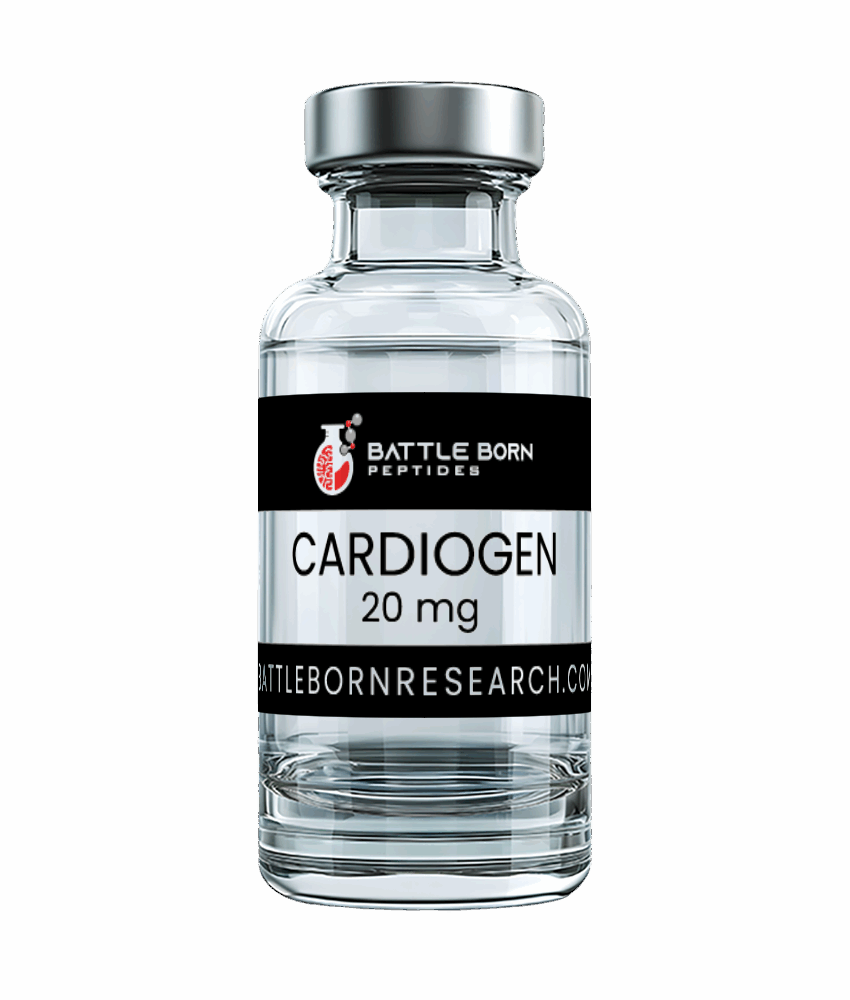
The result published for each Battle Born product is an independent reverse-phase HPLC purity determination, which by its nature does not quantify counter-ions. Our vials carry no production codes; a vial is tied to its published result by the color of its crimp and cap.
Frequently asked questions
Can an HPLC purity result reveal how much TFA a peptide contains?
No. Purity by UV compares peptide peaks with one another, and the counter-ion is not part of that comparison. A separate ion chromatography or 19F NMR measurement is needed.
Why is fluorine NMR unable to measure acetate or chloride?
It detects only fluorine nuclei. Acetate and chloride contain none, so they need proton NMR, ion chromatography or titration instead.
Is a small trifluoroacetate residue after an exchange unusual?
Not at all. Exchanges are equilibrium processes, so a residual level is expected, and the meaningful question is whether it falls below the limit the laboratory stated.
Which unit is most useful for a counter-ion result?
Weight percent is standard, but molar equivalents per peptide molecule show directly how many basic sites carry which counter-ion.
Research use only. All products supplied by Battle Born Peptides are laboratory reference materials for in-vitro research and analytical use by qualified professionals. They are not drugs, foods, dietary supplements, cosmetics or medical devices; they are not approved by the FDA or any other regulator for use in humans or animals; and they are not intended to diagnose, treat, cure, mitigate or prevent any disease, or to affect the structure or any function of the body of humans or animals. Nothing in this article is preparation, handling or dosing guidance. See our full research-use terms.