




What Pinealon is
Pinealon is a commercial name for the tripeptide Glu-Asp-Arg (EDR), three standard L-amino acids with an average free-acid mass of about 418 g/mol. It is the heaviest of the tripeptides we list, and the reason is its C-terminal arginine, whose guanidinium group adds both mass and a positive charge that stays on under any practical conditions.
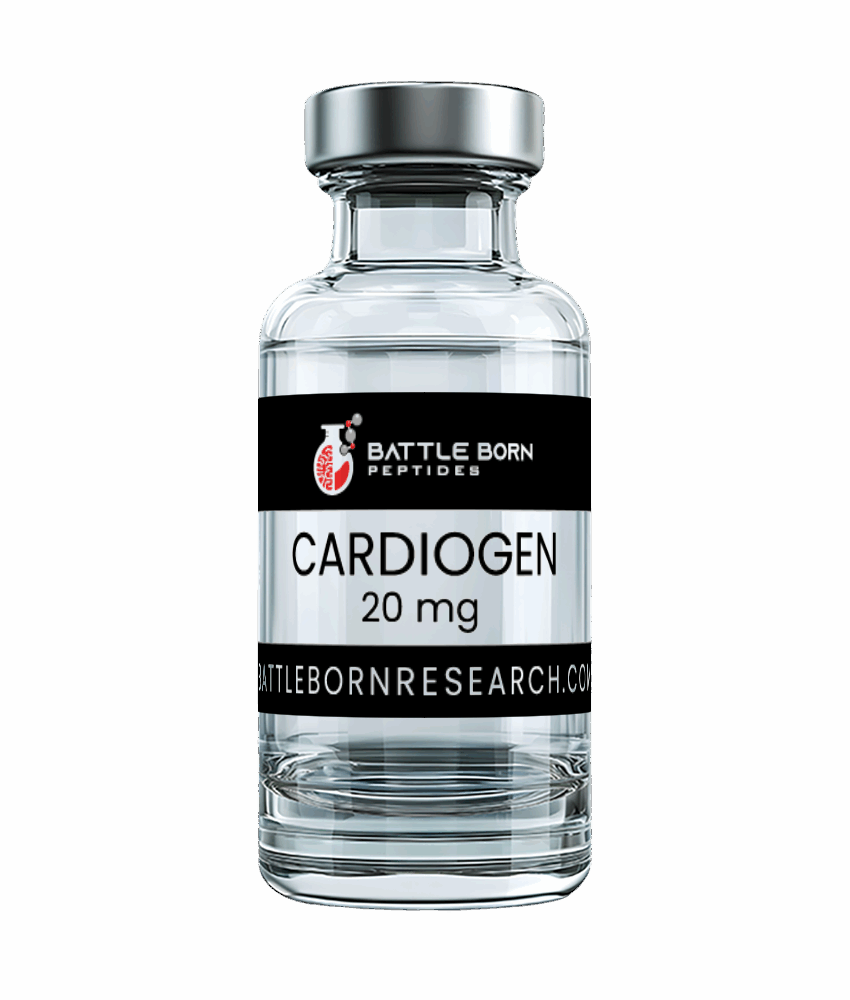
Its most useful neighbor for identity purposes is Cardiogen. Cardiogen’s sequence, Ala-Glu-Asp-Arg, is exactly EDR with an alanine attached at the front, so the pair differ by 71 Da and a mass read-out tells them apart. Chonluten, meanwhile, opens with the same Glu-Asp pair but ends on glycine, which leaves it about 99 Da lighter and strips out the basic charge entirely.
Pinealon 20mg specification
| Catalog name | Pinealon |
|---|---|
| Sequence | H-Glu-Asp-Arg-OH (EDR) |
| Molecular formula | C15H26N6O8 |
| Average mass (free acid) | approx. 418 g/mol |
| Amount per vial | 20 mg |
| Form | Freeze-dried (lyophilized) powder |
| HPLC purity | ≥98% |
| Shelf life | 36 months with the seal intact |
How Pinealon is analyzed
A small peptide carrying two acidic side chains and one permanently protonated arginine has very little to hold it on a C18 surface, so the ion-pairing reagent in the mobile phase is effectively what gives Pinealon its retention. That has a practical corollary: retention time shifts with small changes in additive concentration or pH, two laboratories can report different times for identical material, and identity always rests on the mass, expected just above 418 for the protonated free acid. Arginine can also drag on residual silanols and cause tailing that is a column effect rather than a purity problem. Quantitation uses the low-UV amide band because EDR has no aromatic residue.
Arginine peptides hold on to counter-ion strongly, so for Pinealon the chromatographic purity and the net peptide content can sit further apart than buyers expect. The reverse-phase HPLC purity for this product is published here on its page, and in place of a lot number each vial is matched to that result through its crimp and cap color.
Research contexts for Pinealon
- Ion-pairing reagent comparisons (trifluoroacetic versus formic acid) for small arginine-containing peptides
- Mass-based discrimination of EDR from Cardiogen (AEDR)
- Oligonucleotide-binding assays, such as electrophoretic mobility shift, with a short arginine-bearing peptide
- Counter-ion quantitation by ion chromatography for salt-form determination
Pinealon is provided as a laboratory reagent for in-vitro studies and has no intended use in humans or animals.
Pinealon questions
How is Pinealon related to Cardiogen?
Cardiogen is Ala-Glu-Asp-Arg, the Pinealon sequence with one alanine added at the N-terminus. The extra residue adds 71 Da, so they are distinct compounds that a mass spectrum separates easily.
Why do published retention times for Pinealon disagree?
The peptide’s retention depends mostly on the ion-pairing additive and mobile-phase pH. Different methods place the same material at different times, which is why retention is always paired with a mass for identity.
Why can net peptide content read well below the purity figure?
Arginine binds counter-ions such as trifluoroacetate readily, and on a 418 g/mol peptide that salt is a sizeable share of the powder. Purity describes the peptide fraction; content describes how much of the vial is peptide at all.
Buying Pinealon 20mg in the USA
Orders for Pinealon 20mg ship from a US location with tracking included, and anything above $100 ships at no charge. Labs running Pinealon across repeated experiments can ask us about bulk rates. We release Pinealon exclusively to research institutions, licensed researchers, universities and laboratory R&D purchasers. If an independent third-party test finds purity below the figure published here, section 4 of our refund policy applies. For a fuller account of how arginine shapes the EDR chromatogram, see What Is Pinealon? Sequence, Identity and Analytical Profile.
Pinealon 20mg: in-vitro research material only, not for human or veterinary use.

Reviews
There are no reviews yet.