


Melanotan II is a laboratory designation, not a chemical name. This article is an identity reference for the compound sold under that name: what the sequence is, how the ring is closed, how it differs structurally from Melanotan I and PT-141, how it behaves under reverse-phase HPLC, and how a buyer can confirm that the material in a vial is what the label says. It makes no claim about what the compound does and contains no preparation, handling or dosing guidance.
The sequence and structure behind the name
Melanotan II is a cyclic heptapeptide, conventionally written Ac-Nle-cyclo[Asp-His-D-Phe-Arg-Trp-Lys]-NH2. Seven residues, with four structural features worth naming:
- An acetylated N-terminus on the first residue, norleucine (Nle), a non-proteinogenic amino acid with an unbranched four-carbon side chain.
- A lactam bridge. The side-chain carboxyl of the aspartic acid forms an amide bond with the side-chain amine of the lysine, closing the six residues from Asp to Lys into a ring. Norleucine sits outside the ring as an acetylated tail.
- A D-residue. The phenylalanine is the D-enantiomer.
- A C-terminal amide. The lysine that closes the ring ends in a carboxamide rather than a free acid.
The molecular formula is C50H69N15O9 and the average molecular mass is approximately 1024.2 g/mol.
What the name Melanotan II refers to
Melanotan II is a truncated, cyclised analogue of alpha-MSH, a naturally occurring 13-residue peptide. It corresponds to positions 4 to 10 of that sequence with four changes: norleucine at position 4 in place of methionine, aspartic acid at position 5 in place of glutamic acid, D-phenylalanine at position 7, and lysine at position 10 in place of glycine. The aspartic acid and the lysine are the two residues joined by the lactam bridge. Public databases therefore also list it under a descriptive name along the lines of acetyl-[Nle4, Asp5, D-Phe7, Lys10]-cyclo-alpha-MSH(4–10) amide.
The coined name carries none of that information, and the numeral does not mean “second version of Melanotan I”. The two are different molecules. That is the whole argument for buying on published sequence rather than on name.
How Melanotan II differs from Melanotan I and PT-141
| Compound | Structure | Residues | C-terminus | Approx. MW |
|---|---|---|---|---|
| Melanotan I | Linear | 13 | Amide | 1646.9 g/mol |
| Melanotan II | Cyclic lactam | 7 | Amide | 1024.2 g/mol |
| PT-141 | Cyclic lactam | 7 | Free acid | 1025.2 g/mol |
Against Melanotan I the differences are large and easy to see: Melanotan I is linear, thirteen residues long and about 620 Da heavier. Any competent mass confirmation separates them immediately.
Against PT-141 the difference is small enough to be missed. PT-141 has the identical ring, the identical tail and the identical residues; the only change is that PT-141 ends in a free carboxylic acid where Melanotan II ends in an amide. The formulas differ by exchanging one NH group for one oxygen, and the average masses differ by about 1 Da. On a high-resolution mass spectrometer that is clearly resolved. On a lower-resolution instrument, or in a report that rounds the observed mass to the nearest whole number, it may not be.
How Melanotan II behaves on reverse-phase HPLC
Norleucine, D-phenylalanine and tryptophan give Melanotan II substantial hydrophobic surface, while arginine and histidine carry positive charge under acidic mobile-phase conditions. On a C18 column with an ion-paired acidic gradient it retains well and elutes mid-gradient, far from the solvent front. The conformational constraint of the lactam ring tends to produce a sharper, more symmetrical peak than a flexible linear chain of similar mass.
The amide and free-acid forms can elute close together, and their relative order depends on the pH and the ion-pairing additive. A retention time on its own is therefore not enough to tell Melanotan II from PT-141; it has to be read with a mass.
Tryptophan absorbs strongly near 280 nm, so the compound is visible there, but purity is normally read on the peptide bond at around 214 nm so that non-aromatic impurities are counted as well. A certificate should state which wavelength was used; the guide to reading an HPLC chromatogram explains why it changes the purity figure.
What an analysis for Melanotan II should show
A useful certificate reports the column chemistry and dimensions, the mobile phase and gradient including the ion-pairing additive, the detection wavelength, the retention time, the integrated peak area with the integration window visible, and a mass confirmation consistent with approximately 1024 g/mol — ideally stated to one decimal place, with the instrument type named, so that the amide can be distinguished from the acid.
It should also report net peptide content separately from chromatographic purity, and name the counter-ion. Melanotan II is normally isolated as a salt, commonly acetate, and the counter-ion adds weighed mass without adding peptide. The article on TFA versus acetate counter-ions covers how that affects the numbers.
The D-phenylalanine is invisible to mass measurement: a racemised sample has exactly the same mass as correct material, and only a chromatographic separation can show it.
Confirming identity independently
Search on the structure, not the name. Public chemical databases index Melanotan II by structure and by its descriptive alpha-MSH-analogue name, and a search using the cyclo notation and the C-terminal amide will show quickly whether the formula and mass a vendor quotes match the ones everyone else uses. A quoted mass near 1025 suggests the free-acid form, and a quoted mass near 1647 suggests Melanotan I; either is worth resolving before the vial is opened.
How Melanotan II is supplied here
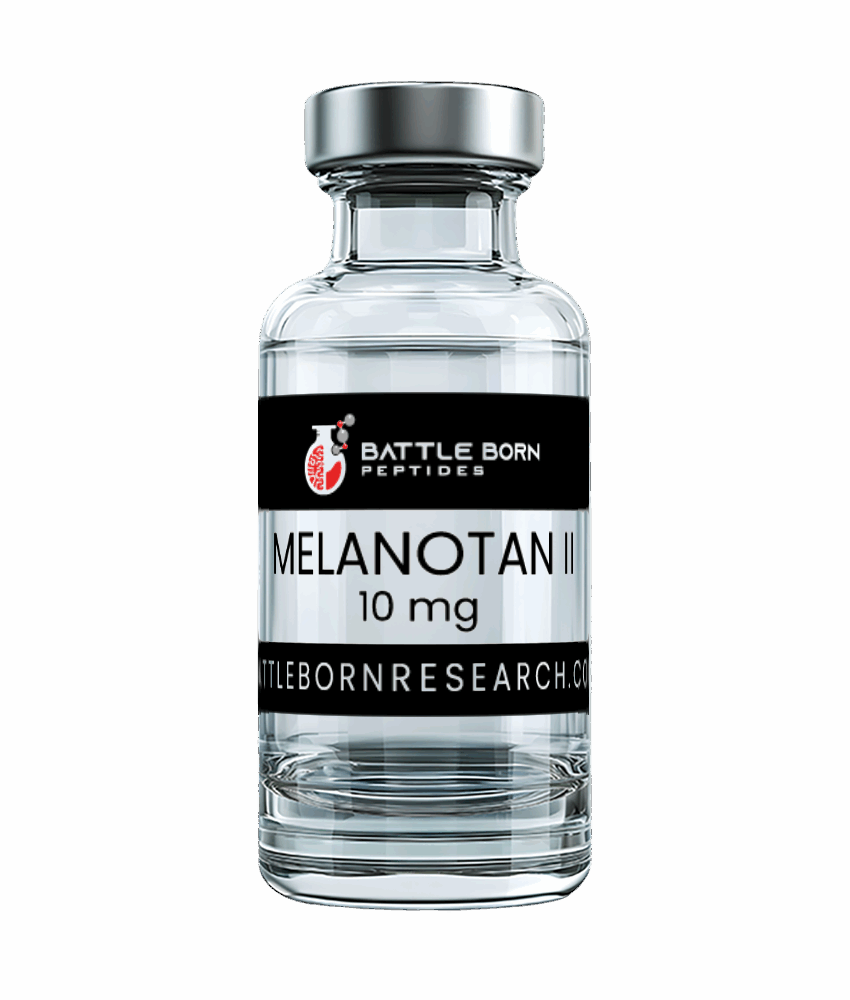
Melanotan 2 10mg is supplied as a lyophilised powder in a sealed vial. It is analysed by independent reverse-phase HPLC, and the result is published for that product. Vial size and the published HPLC purity are listed on the product page. No batch or lot code appears on a Melanotan II vial; instead, its crimp and cap color link it to the published test.
Frequently asked questions
What is the sequence of Melanotan II?
Ac-Nle-cyclo[Asp-His-D-Phe-Arg-Trp-Lys]-NH2: an acetylated cyclic heptapeptide with a lactam bridge between aspartic acid and lysine and a C-terminal amide.
Is Melanotan II a longer or shorter peptide than Melanotan I?
Shorter. Melanotan II has seven residues arranged partly in a ring; Melanotan I is a linear chain of thirteen.
What is the only structural difference between Melanotan II and PT-141?
The C-terminus. Melanotan II is an amide and PT-141 is a free acid, a difference of about 1 Da.
What molecular weight should I expect for Melanotan II?
Approximately 1024.2 g/mol for the neutral molecule, C50H69N15O9. A salt form weighs more in bulk, which is why the counter-ion must be declared.
Research use only. All products supplied by Battle Born Peptides are laboratory reference materials for in-vitro research and analytical use by qualified professionals. They are not drugs, foods, dietary supplements, cosmetics or medical devices; they are not approved by the FDA or any other regulator for use in humans or animals; and they are not intended to diagnose, treat, cure, mitigate or prevent any disease, or to affect the structure or any function of the body of humans or animals. Nothing in this article is preparation, handling or dosing guidance. See our full research-use terms.