



This article is an identity reference for seven short synthetic peptides that are sold under coined names — Cartalax, Chonluten, Livagen, Pinealon, Cortagen, Cardiogen and Epithalon — and that are often grouped together as “bioregulators” or “Khavinson peptides”. Those are used here purely as names for the family. The article sets the seven sequences side by side, compares their masses, and explains how they behave analytically. It does not describe what any compound here does, and it offers no preparation, handling or dosing guidance.
The seven sequences side by side
Each of these compounds has its own identity reference on this site, linked in the first column. The values below are taken from those articles and cross-checked against public chemical databases. Masses are average molecular masses for the neutral free-acid form, rounded to the nearest whole number.
| Name | Sequence | Residues | Approx. average MW |
|---|---|---|---|
| Chonluten | Glu-Asp-Gly (EDG) | 3 | 319 g/mol |
| Cartalax | Ala-Glu-Asp (AED) | 3 | 333 g/mol |
| Epithalon | Ala-Glu-Asp-Gly (AEDG) | 4 | 390 g/mol |
| Pinealon | Glu-Asp-Arg (EDR) | 3 | 418 g/mol |
| Cortagen | Ala-Glu-Asp-Pro (AEDP) | 4 | 430 g/mol |
| Livagen | Lys-Glu-Asp-Ala (KEDA) | 4 | 461 g/mol |
| Cardiogen | Ala-Glu-Asp-Arg (AEDR) | 4 | 489 g/mol |
All seven are built entirely from standard L-amino acids, with no non-natural residues and no terminal modification in the common free-acid form. All seven contain an adjacent Glu-Asp pair. Four of them — Cartalax, Epithalon, Cortagen and Cardiogen — share the full Ala-Glu-Asp core and differ only in what, if anything, follows it at the C-terminus.
Why the names are designations, not identifiers
None of these seven names encodes any structural information. “Cortagen” and “Cardiogen” sound alike and differ by one residue; “Cartalax” and “Epithalon” sound unrelated and differ by one glycine. The names were coined for the compounds rather than derived from them, so the only way to know what a vial is supposed to contain is to read the sequence.
That has a concrete consequence when comparing suppliers. Two vendors can sell the same name and ship different sequences if one of them has the pairing wrong, and nothing on the label will show it. The sequence, printed next to the name, is the identifier; the name is a label attached to it. Search public databases by sequence rather than by trade name and the pairing can be checked in a minute.
Close masses are the second trap. Chonluten and Cartalax differ by about 14 Da; Pinealon and Cortagen by about 12 Da. On a well-calibrated instrument those differences are unmistakable, but a mass reported only as “consistent with” a round number can hide them. The observed value should be stated.
How short acidic peptides behave on reverse-phase HPLC
Every sequence in this family is short and carries two acidic residues. That combination makes them very polar, and polar analytes retain poorly on a C18 stationary phase. They elute early, often close to the solvent front, in the region where salts, residual reagents and other polar synthesis by-products also appear. The guide to reading an HPLC chromatogram explains why that region is the hardest place on a trace to integrate honestly.
Within the family there are useful differences:
- Purely acidic sequences — Chonluten, Cartalax and Epithalon — are the least retained. EDG, with a glycine and no hydrophobic side chain at all, is the most polar of the seven.
- Proline in Cortagen adds a small hydrophobic ring and slightly improves retention compared with its Ala-Glu-Asp relatives.
- Basic residues — the arginine in Pinealon and Cardiogen, the lysine in Livagen — add a positive charge. Retention of these sequences depends heavily on the ion-pairing additive in the mobile phase, and retention times reported by different laboratories can legitimately differ for identical material.
None of the seven contains tryptophan, tyrosine or phenylalanine, so none absorbs usefully at 280 nm. Every analysis in this family has to be read on the peptide bond at around 214 nm. A purity figure quoted without the column, gradient and wavelength tells you very little for compounds this small, and a shallow gradient with a low starting organic percentage does real work in separating them from polar impurities.
Why the counter-ion matters more for small peptides
Synthetic peptides are isolated as salts, typically trifluoroacetate or acetate, and the counter-ion contributes mass to the powder without contributing peptide. The mass of a counter-ion is fixed, so its share of the total grows as the peptide gets smaller. A counter-ion that is a minor fraction of a 3,000 g/mol peptide is a substantial fraction of a 319 g/mol one.
The basic sequences add a further twist: an arginine or lysine side chain can carry its own counter-ion in addition to the N-terminal amine, so Pinealon, Cardiogen and Livagen can carry proportionally more counter-ion than the purely acidic members of the family. That is why net peptide content must be reported separately from chromatographic purity, and why the counter-ion must be named. The articles on purity versus net peptide content and TFA versus acetate counter-ions go into the arithmetic.
What an analysis should show for any of the seven
Column chemistry and dimensions, mobile phase and gradient including any ion-pairing additive, detection wavelength, retention time, integrated peak area with the integration window visible, an observed mass that matches the table above for the free acid, net peptide content, and the counter-ion. For the four Ala-Glu-Asp compounds in particular, the observed mass is what distinguishes one from another.
How the bioregulator peptides are supplied here
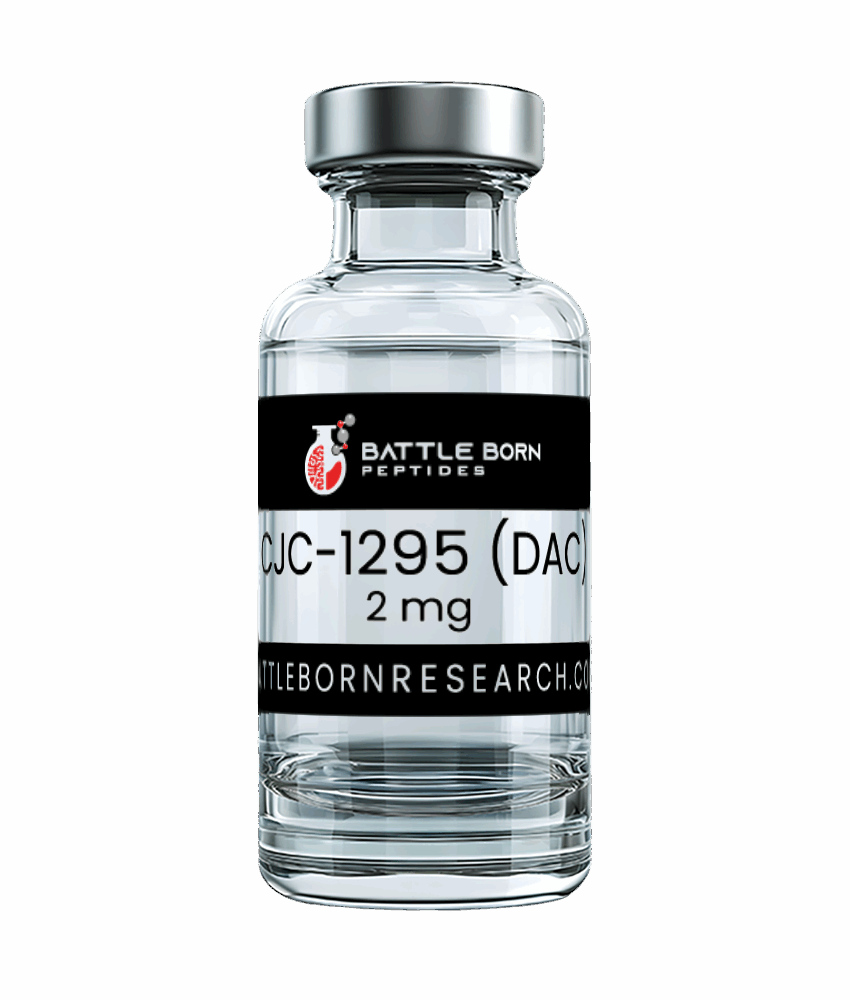
Each compound is supplied as a lyophilised powder in a sealed vial: Cartalax 20mg, Chonluten 20mg, Livagen 10mg, Pinealon 20mg, Cortagen 20mg, Cardiogen 20mg and Epithalon 10mg. Each of these bioregulators has its own independent reverse-phase HPLC result on its product page. The Battle Born product page lists the vial size alongside the published HPLC purity. Battle Born vials are not lot-numbered; instead, its crimp and cap color link it to the published test.
Frequently asked questions
Which of these peptides share the same core sequence?
Cartalax (AED), Epithalon (AEDG), Cortagen (AEDP) and Cardiogen (AEDR) all begin Ala-Glu-Asp. They differ only at the fourth position, or, in the case of Cartalax, by having no fourth residue.
Which is the smallest and which the largest?
Chonluten (EDG) is the smallest at about 319 g/mol. Cardiogen (AEDR) is the largest at about 489 g/mol.
Why do they all elute so early on HPLC?
They are short and each contains two acidic residues, so they interact weakly with a reverse-phase column. Early elution is expected, which is why the method has to be chosen to separate them from polar impurities.
Can they be detected at 280 nm?
No. None contains an aromatic residue, so all of them are read at around 214 nm.
Does “bioregulator” describe the structure?
No. It is a family name, like the individual trade names. The sequence is the only structural identifier.
Research use only. All products supplied by Battle Born Peptides are laboratory reference materials for in-vitro research and analytical use by qualified professionals. They are not drugs, foods, dietary supplements, cosmetics or medical devices; they are not approved by the FDA or any other regulator for use in humans or animals; and they are not intended to diagnose, treat, cure, mitigate or prevent any disease, or to affect the structure or any function of the body of humans or animals. Nothing in this article is preparation, handling or dosing guidance. See our full research-use terms.