

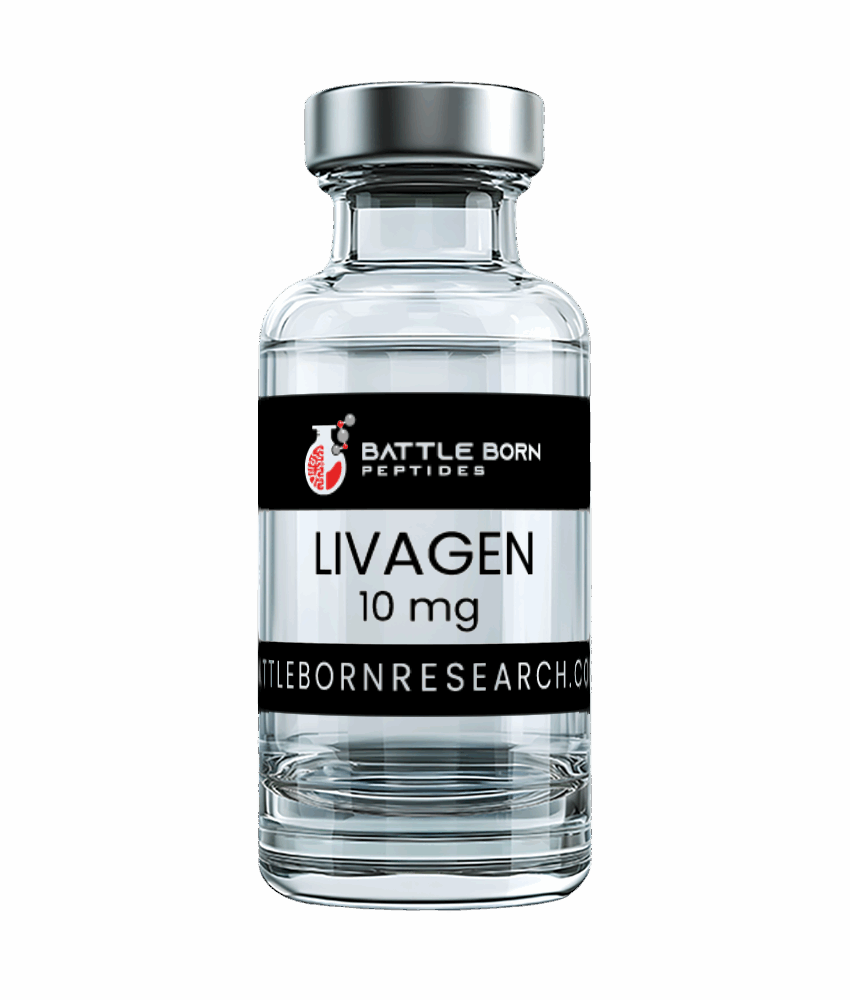

Livagen is a trade designation for the tetrapeptide Lys-Glu-Asp-Ala. This is an identity reference: sequence, expected mass, analytical behaviour and verification. It makes no claim about what the compound does and contains no preparation, handling or dosing guidance.
The sequence behind the name
Livagen is Lys-Glu-Asp-Ala, abbreviated KEDA. Four residues, all standard L-amino acids, average free-acid mass approximately 461 g/mol.
It is the one sequence in this group that is not purely acidic. Lysine contributes a basic side chain alongside the glutamate and aspartate, which makes Livagen zwitterionic across most of the useful pH range and gives it different chromatographic behaviour from its neighbours in the same catalogue category.
Why the basic residue changes the analysis
A free lysine amine does two things that matter to a buyer reading a chromatogram. It interacts with residual silanols on a silica-based C18 column, which can produce peak tailing that has nothing to do with purity and everything to do with the column and the mobile-phase additive. And it makes the retention time genuinely pH-sensitive, so the same material run under a slightly different mobile phase can move.
The practical consequence: an ion-pairing additive such as trifluoroacetic acid is doing significant work in a Livagen method, and a chromatogram showing a tailing peak is not automatically showing an impure sample. Ask what the mobile phase was before drawing a conclusion from peak shape.
Naming
As with Cartalax, Chonluten and Epithalon, “Livagen” is a coined commercial designation and carries no structural meaning. Verify by sequence.
What an analysis should show
Column and dimensions, mobile phase and gradient including the ion-pairing additive, detection wavelength, retention time, integrated peak area, and mass confirmation near 461 g/mol for the free acid. Then, separately, net peptide content and the counter-ion form.
KEDA has no aromatic residue, so 280 nm detection is not available and the analysis has to be read at approximately 214 nm on the peptide bond.
Confirming identity independently
Search public chemical databases on Lys-Glu-Asp-Ala rather than on the word Livagen. Product pages here carry identity links that run that query directly.
How Livagen is supplied here
Livagen 10mg is supplied as a lyophilised powder in a sealed vial with an independent reverse-phase HPLC analysis on the product page, plus net peptide content, counter-ion form and vial size. Vials carry no batch or lot numbers and are matched to their published test by crimp and cap colour.
Frequently asked questions
What is the sequence of Livagen?
Lys-Glu-Asp-Ala (KEDA), a tetrapeptide.
What molecular weight should the mass spectrum show?
Approximately 461 g/mol for the free acid. A trifluoroacetate or acetate salt will read higher.
Is Livagen related to Epithalon?
They are separate sequences that belong to the same naming family. Epithalon is Ala-Glu-Asp-Gly; Livagen is Lys-Glu-Asp-Ala. Same catalogue category, different compounds, different analyses.
Why does my Livagen peak tail?
Most often because the lysine side chain is interacting with free silanols on the column, which is a column-and-mobile-phase effect rather than a purity effect. The method description should tell you whether an ion-pairing additive was used.
Research use only. All products supplied by Battle Born Peptides are laboratory reference materials for in-vitro research and analytical use by qualified professionals. They are not drugs, foods, dietary supplements, cosmetics or medical devices; they are not approved by the FDA or any other regulator for use in humans or animals; and they are not intended to diagnose, treat, cure, mitigate or prevent any disease, or to affect the structure or any function of the body of humans or animals. Nothing in this article is preparation, handling or dosing guidance. See our full research-use terms.